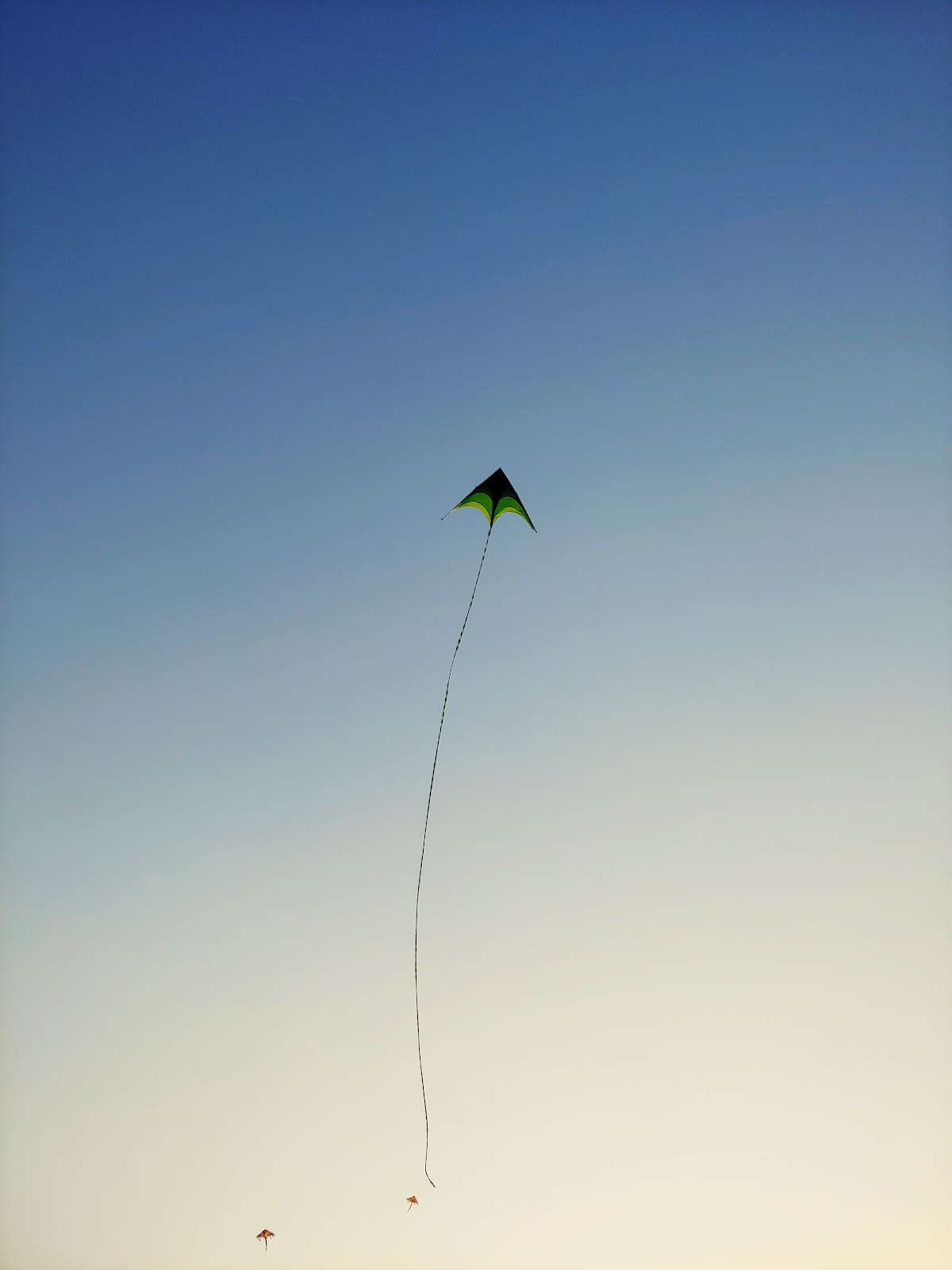
I suppose usually, we would wait until the kite dives into the grass hummocks of the field. In that case, the string goes slack, and retrieving the kite becomes a matter of spooling the inert cord back onto the plastic handle.
I suppose usually, we would wait until the kite dives into the grass hummocks of the field. In that case, the string goes slack, and retrieving the kite becomes a matter of spooling the inert cord back onto the plastic handle.
This time, my three year old son wanted to hold the handle. The kite string, a thread of nylon as thin as embroidery floss, was improbably canted into the sky, tugged by a sail shaped like a dragon and being tossed by the heavier winds that start about eighty feet aloft. It is one thing to release a helium balloon into the sky (though you shouldn’t). The experience of watching an object fall upward is exhilarating, disorienting, resetting of expectations, even vertigo-inducing…such is our imprisonment in gravity, that mysterious force that seeks always to move us closer together, crush us all into One. And, indeed, helium, given the chance, will eventually escape Earth altogether, and fly off into space, a one-way cosmic voyage. However, once you let go of the balloon, you are free. Though you are bound by the thought of the balloon, the awareness of it, you cannot be responsible for what happens to it. But the kite — that is something you are still holding as it thrashes upon the sky; that is a thing you have to reel in.
The air itself, the wind, is ripping against you, like a marlin pulling on a fishing line. You reel it in, the line tugs upward, a very strange sensation. You wonder how the line can absorb such force, and you wonder if you can contain the thing you incautiously launched into the ocean sky, and draw it back to you. My son and I held the handle together.
I describe all this by way of analogy. Perhaps the single defining feature of human existence is our compulsive desire to manipulate other people so that they share our experience. This incessant effort to move other people so they feel and think the same things together is unparalleled by any other species of animal that exhibits individualized choice and not hive mind. It is akin to hauling the sky down to meet you at the bitter end of a slender thread, and our habitual attempts to do so reveal both important insights not only about who we are and how we exist, but why we obsessively destroy our environment to dominate and master it for experiential consumption by our people.
At its root, prison is designed to hurt people. It’s drab, cheerless colors, hard surfaces, harsh lighting, cramped quarters and oppressive industrial aura are meant to hurt your eyes and your heart, feel unkind on every level. Prison is a shiv in the gut — it steals joy and life like something unnaturally cold steals warmth and never gives it back.
We call it the Department of Corrections now, and it represents society’s most heavy-handed attempt to pull up an individual’s entire life experience by the roots and replace it with a different program of sensory perception, interpretation, and behavior. It is still a penal system, meant to punish. It is meant to force the individual into an experience of suffering. Everyone in prison is supposed to have a bad time — prison is designed to produce that result.
Perhaps this is hammering on the obvious, but it’s worth looking squarely at the truth that prison represents a hidden pole of fear in our society…a hidden black hole of a place where a uniformly hellish experience is created for you that you can’t escape. This is the ultimate in trying to make another person share in a subjective experience: a guaranteed nightmare.
The ultimate in controlling another’s experience is dispassionately killing them, not because we hold bitterness toward them, but because we want to make the other person feel the emotional consequences of that finality. In the fall of 2022, Gizmodo reported that the founder of the virtual reality company Oculus, Palmer Luckey, has created a prototype of a VR headset that is wired to explosives placed around the headband. That way, if your playable character dies virtually, you can also die for real. What’s holding Luckey (or any other of the gamer-designers) back from trying out the “murder helmet” is not the intrinsic obscenity of tying their precious lives to the outcome of an artificial adventure, but fear that the game would get it wrong, and kill them due to a glitch in the software. Other than that, Luckey is ready to govern life and death through the user interface.
You instantly raise the stakes to the maximum level and force people to fundamentally rethink how they interact with the virtual world and the players inside it. Pumped up graphics might make a game look more real, but only the threat of serious consequences can make a game feel real to you and every other person in the game.
Luckey is angling to make the headgear impossible for the user to remove as well.
It is easy to read about Palmer Luckey’s murder helmet and feel estranged from those desires to be robbed of the capacity to take something less seriously and to exact revenge — but the truth is, we all try in both subtle and gross ways to shape the experiences of each other, dragging autonomous beings into coordinated subjectivity.
We coach our children (either deliberately or inadvertently) on “appropriate” social behaviors and responses. In doing so, we begin — from a very early age — to taper each child’s expectations of reality, inwardly and outwardly, to a narrowing band of perception of what’s possible and allowable. We place heavy emphasis on understanding, agreeing, permission-seeking, following directions and protocol. These are all avenues of conformity, when so elevated.
Also, we advertise to each other, constantly. As children, we perfect a cry that shatters our parents’ mental landscape until they deal with us. Then, we refine that skill for later purposes. We wheedle, we cajole, we repeat and repeat and badger and nag. We do our best to eliminate the possibility of no.
When we get older, we learn to seduce, seduce with the rhythm of our speech, with the visions painted by metaphor, with the sensual, fractally regressing invitation of an idea, with the double meaning of a word. We arrange our environments to create experiences for ourselves and for others constantly — far beyond the showy feathers and dance of a Bird of Paradise or the sexual exaggerations of a thousand other species. We try to shape every square inch and every ticking second of our fret upon the stage…which is odd, isn’t it? Shouldn’t it be manifestly apparent that we cannot control reality? And, why are we actually able to do so — to make someone think what we think and feel what we feel so intensely…if only for a very short time?
The standard explanation involves entrainment to a simple harmonic. Fireflies converge to flash in unison. Footsteps in sync can bring down a suspension bridge. Heartbeats align. Seemingly out of nowhere, a crowd swells with the same emotion. A chant or a cry rings forth.
We are optimized to harmonize and match with each other, just as millions of entities are behaviorally converging with each other, coordinating beyond complementarity and verging on identicality. Yet…from the vantage of subjective experience, we know first-hand that humans are uncomfortable when we’re not in synchrony with each other and sharing a coordinated, orchestrated experience — we end up feeling misunderstood. Actually, most of us want to feel enthralled by at least one experience in our lives — even if being a thrall implies being a servant in the control of someone else.
This is to say, most people are naturally seeking of an experience that has an undertow of convergence within it; and things feel “off” when that current isn’t present. We subconsciously seek to align ourselves to collective flocking experiences.
But, let’s look closer: Aren’t we uncomfortable when someone copies us too closely? Sympathy creates exciting opportunities…commiseration does not. We are not (usually) moving on a straight-line collision course to be conjoined in perceptions and passions, but bending the curve toward the asymptote of identical experience…and then we whirl off in a new direction. We want understanding…by way of new light shed on the subject, new ideas, the tantalizing possibility of a new consciousness playing our character and getting fresh results.
This is apparent if we flip the equation. The whole premise of Greek tragedy rests on having a protagonist who is thoroughly familiar and captivating, yet who is pushed by his flaw — his un-reproducible and fateful error — into his singular, catastrophic doom. The audience glides by — almost, but not quite, in the same boat.
Then, there’s this: my dad used to play double-bass in a community orchestra in London. He once told me a story of a time during a rehearsal when all the double-bass players decided to tune their instruments as accurately as possible to each other, as a prank. As the conductor called them in, on their cue in the music, a great basement roaring sounded forth that swamped the entire rest of the orchestra. It turns out that the resonance of the orchestra depends upon the imperfection in the harmonic sympathy of its constituent parts. An orchestra that sings too ideally together overwhelms itself and shatters.
Let’s think more about what this asymptotic curve, this limit approach, of identical experience means. To be identical means to share the same identity. The grand register of the Universe’s index of unique interactions from the beginning of time until the creation of You can’t be copy-pasted to another entity, or stretched to include another…can it?
Leave off the reports of individuals encountering doppelgängers of themselves or others they know (stories that are, themselves, astonishingly identical in their structure and details), what other mechanism could yield moments of identicalness as a feature of a Universe rife with disparate and divergent history trails? What are we missing here?
Possibly, the breakthrough lies in considering ourselves as focused processes with a beat and a rhythm, like a series of standing waves in the course of a river, or a whirlpool — rather than discrete objects that can be considered on or off the board of reality, like chess pieces. We are tuned by the harmonics of the conditions around us, inside us, through us, appearing at every scale. When those tunings are particularly resonant, we are “pulled into frame” with them, squared up and organized with incredible precision, perhaps with infinite precision. Yet, can two whirlpools appearing in succession in the same spot upon the tidal pool be truly identical? Perhaps they can, if the conditions are sufficiently conformative.
Now, flip the picture on its head. Suppose there is only ever one whirlpool. Easy enough for us to wrap our minds around that conceptually, in a way; just as there is one river, though the water itself may be endlessly different. But what about, say, a hydrogen atom? Suppose there is only one hydrogen atom in the universe, scattered prismatically (or distributed via a grand wave function) into every cameo appearance throughout the cosmos.
We could then ask: what is the cause of difference itself — of two or more — rather than the original cause and allowance of identicalness or unity. From where comes type, instances of multiple things that are similar but not identical?
Indeed, the interplay on the threshold where echoed unity becomes truly differentiated similarity (and vice versa) is surely complex, given that it is evolving in real-time, and is populated by “objects” which are not exclusively one state or the other, but both, depending on the context—contexts which exist simultaneously.
Clearly, this is a fantastically complex web of reflected unity. We are ghosts looking at own reflections repeated a thousand times in the facing mirrors, startled when the reflections don’t quite match: a strange turn of the eye, a sideways smile. It is a realm in which we compel and are compelled in turn.
It is the foundational origins of powerful charisma and sway over others, but it is not selective. We all carry this capacity, in different ways. What it is not for — what it could not be for, given the schema — is personal empowerment through the forcing of any will that is out of step with the whole.
Free will is a false myth. There is an uncomfortable truth which is that we are — individually and specifically — far more predictable than we would imagine that we are, particularly in our responses to events. This is why “psychic” cold reading works. This is how advertisers find your pressure points of persuasion. This is the explanation for the phenomena discovered by researchers studying decision-making, who have found that rewording a posed moral quandary can very predictably shift which course of action respondents choose — even if both courses are logically equivalent.
We are predictable because we filter our perception of reality predictably. We winnow our expectations to a handful. Yet, that does not mean that we are non-participants in worlds beyond our filtered awareness.
Quite the contrary. Again, we hold the sky on a kite string. What’s interesting is that we may be compelled to try and reel in the sky not merely on account of convergent behavior within the framework of our limited expectations and narratives, but via networked weavings that happen outside of the constrained Umwelt of our sensory perceptions, and the definitions that arise from those perceptions and shape the possibilities in our thoughts.
Outside the Umwelt of our understanding lie the contours of a universe whose narratives, motives, dynamics are as difficult for us to perceive directly as utra-violet light…and yet, we fluoresce with perceptions and behaviors as a result of those forces that operate on that hidden landscape.
In Brazil, there is a strange legend called the Sete Alem, or “Seven Beyond.” It refers to a realm or dimension that resembles this world but is shadowy and ruinous, populated by distorted doppelgängers of our people who peer out with sunken eyes that blaze with unnatural intensity. The Sete Alem is relatively easy to stumble into—though you never know quite when it will happen. Stories abound of walking through ordinary doorways, or boarding a standard city bus, and ending up in this warped looking glass place. The denizens always notice you, always find you, and adamantly, ferociously insist that the people from our world don’t belong there. Legend says they will drive you out.
A popular interpretation of the Sete Alem is that it is somewhere else, like a parallel universe. However, an equally valid interpretation is that the Sete Alem is this world with the blinders off, an expanded reality that reveals hidden aspects of our nature that our operating beyond the range of our normal perception.
The Cheshire Cat Illusion comes into play here. Points of stillness hidden by visual fields in motion is a good conceptual model for how we routinely miss the Sete Alem — except that the hidden world is not staying still, but rather moving to its own appointments of attraction and repulsion…and, perhaps, dynamics that we cannot even fathom because we have no Piagettian developmental model of the world to contain them. They fit no analogy we know or story we tell. But—again— this does not mean we don’t participate in such realms beyond this Umwelt we customarily inhabit. Go to the Sete Alem, and we find ourselves seen through a different lens, urgently telling ourselves to leave that mode of perception, because it’s dangerous.
Why is it dangerous? My guess is that being there damages our experience of free will. We can’t control the convergences of life and identity. The kite string lifts us high into the sky, and we lose our bearings. We don’t typically have the patience to endure even a mistake, like Sylvester and his Magic Pebble, turning into a boulder for a year, and just see what happens. We don’t customarily know how to participate in non-human stories with much staying power, most of us only stand in front of extraordinary zoo exhibits for only a minute or two.
Who or what within the bee decides how long it will hover at one flower before it moves on to another? Do gnats circling in the twilight gloom get bored? Other Umwelten create new capacities and motivations. The Sete Alem is beyond the tragic or the comedic. One of the common threads in reported paranormal experiences is spectres and creatures staring at us from odd angles, inserting their heads into the frame of our normal from strange vantage points. Since we are participants in these other Umwelten…what are we up to there? What do we care about there? Are we as weird as everybody else?
I have attempted to sketch out a possible topography of attractions and divergences, congruency and differentiation, that illuminate both the origins and strength of our constant desires to shape each other’s experiences, as well as the limitations of the stories we reference to encode those dynamics in our collective subconscious. Here is one final point to consider. The next natural question is to wonder whether there are points of contact between the simple harmonics and modes of human stories and the transmogrifications that happen in other Umwelten that are not tuned to human senses and survival.
Answer too hastily, and we risk once again anthropomorphizing the whole universal portfolio of activity, to our own blind detriment. On the other hand, the general fractal self-similarity of the Universe suggests there are certain similarities to all narratives and motivations, even if they become rarified in other contexts far removed from our familiar.
But here’s the point: regardless of whether we conceptually understand every layer of what is going on simultaneously, we are participating in all the layers, all the time–sometimes with emphasis, sometimes diffusely or clandestinely. Knowing that we are compelled by such an immense and intricate symphony of forces is Jungian analysis on steroids: it gives pause to our automatic gestures, and hands us a limitless codex to deciphering the in situ meaning of Self.