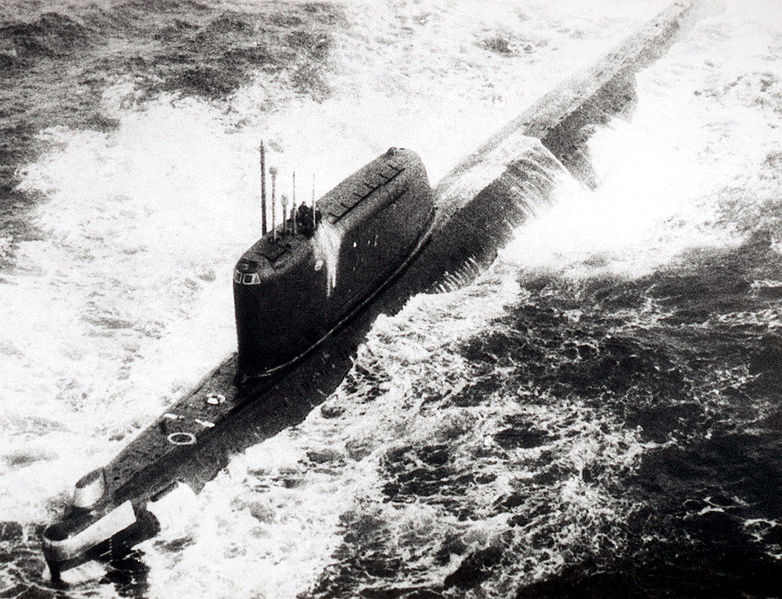
The year is 1962. Three days before Halloween, and the world is holding its breath. Russia and the United States are on the brink of nuclear war; medium-range ballistic missiles have been brought by the Soviets to the island of Cuba. Edward Teller’s terrible machine waits in the armories of two lethal enemies circling each other.
It is hard to fathom what a thermonuclear bomb truly is—the family of events to which it belongs are remote and cosmological. An incomprehensibly powerful compression wave, triggered by an atomic blast, forces hydrogen atoms to merge in a way they only do in the terrible maelstrom of a star’s heart. The desire to break open a star’s heart upon the shore of the world had long since wrestled the ethical question of why humanity should want to take such a remote astronomical collision and make it real—wrestled it to the ground and killed it; and now, in less than ten minutes, Earth can be destroyed.
Beneath the waves of the Sargasso Sea, a Soviet diesel-powered submarine, the B-59, has lost contact with its chain of command stretching back to the Kremlin. Sunk some 650 feet below the waves, the sub has run low on fuel; the air-conditioning has stopped functioning. Carbon dioxide is filling the air dangerously, and temperatures are soaring. In the crowded vessel, crew members are passing out with heat stroke. They have onboard twenty-two missiles—one of which contains a ten-kiloton fission warhead, in the same class of weapon as Little Boy, which exploded over Hiroshima.
At depth, the submarine can no longer pick up radio stations from Miami, its last link to news and the current state of affairs. The Soviet sailors also do not know that an American destroyer group, positioned with President Kennedy’s naval blockade of Cuba, has been tracking the B-59 for three days and has finally located the sub. The USS Beale, the USS Cony, and other destroyers begin closing in on the position of the B-59 while dropping signaling grenades, which the American sailors decry as “firecrackers.” With their commanding officer’s tacit approval, the sailors begin placing the grenades in toilet-paper tubes, which dissolve hundreds of feet down, bringing the explosive charges much nearer to the hull of the submarine itself. What they perhaps do not realize is that, in the stifling and hypoxic conditions aboard the B-59, the paranoid commanders dream that they are under attack and that war has begun.
The captain of the submarine orders the officer in charge of the one nuclear weapon to arm and prepare the torpedo. Allegedly, the captain says, “We will die, but we will sink them all.”
On Foxtrot-class submarines at this time, only the consensus of two commanding officers is required to deploy the nuclear weapon. Captain Savitsky and Political Officer Maslennikov agree that war has begun topside, and that the time has come to launch the atomic torpedo at the American destroyers. However, the B-59 is also carrying the Chief of Staff of the battalion of four Foxtrot-class submarines in the Sargasso Sea; Vasily Arkhipov is, in other respects, equal in rank to Savitsky. Because he is present on the ship, he also gets a say in whether to go nuclear.
In Arkhipov’s mind, there is doubt.
Sweltering in a metal can now lit only by dim emergency lighting, Arkhipov is completely cut off from signal—from humanity. He is surrounded by men losing their minds under carbon monoxide poisoning. His two fellow senior officers are confident in their fatalistic assumption that all hope is lost and that a hell of immense suffering is about to be ignited. Arkhipov is in the vice of the most profound pressure any human being has ever known. And yet—and yet—he has a different perception in his mind and a different feeling in his heart than his fellows. He believes the world is not dead.
There is, in the end, no logical reason for Vasily Arkhipov to come to a different conclusion, or even to entertain reasonable doubt, given the barrage of psychological and physiological stresses consuming him and every other member of the crew at that moment. There was tremendous peer pressure to agree to participate in the end of the world. Neither Sophocles nor Shakespeare could have dreamt up circumstances more poisonous to hope, or more evilly encouraging to whatever fatal flaws of character might be hardwired into the chemical cybernetics of a troop of hominin apes stuck in a steel can beneath the ocean in October of 1962. For those who argue that the mind is a phenomenon—or epiphenomenon—of the brain; that physics and accident set the ground for the activity of the universe; that meaningful relationships are artificial constructions of the perceiver, Vasily Arkhipov is a miracle out of madness: the man who saved the world with a capacity for optimism that arrives deus ex machina.
In a wild turn of events, Occam’s Razor suggests, more efficiently, that we are not alone—either in substance or in meaning.
Pressed to the very extremes of isolation and solipsism, still we find connections to larger patterns of possibility. This is because the discretization and isolation we customarily perceive are not the natural order of the world, but limits of perception. Not a thousand Rumplestiltskins could spin our straw model of reality into the necessary gold required to give confidence to our sense of belonging and agency in the expansive and mysterious universe that involves us and conscripts us to its very strange play. There is an utterly different kind of process at work—and a different model is needed to both adjust our comprehension and refine our participation.
This manuscript describes a framework for a generative field of meaning that is not limited to the contours of apparent physics, but flows with interconnectedness that not only implies we are never alone, but that we are never independent. Every event, every action, has network impact. We are accustomed to thinking that the events which happen to us, as well as the events we instigate, are limited in effect, with the limiting factor being a ripple pattern that diminishes in amplitude proportional to the square of the distance from the epicenter. This is a pattern we see repeated in nature so often that it has become almost inextricably ingrained in our perceptual bias.
Almost.
The result is one of the most difficult and damaging obstacles to what we might call attuned-responsive agency (or “passion-perfect” action): the pervasive sense that the world does not care about who we are and what we do, that the inertia against propagating effect is just too high. And even when we do manage to make a splash and entrain local reality to responsiveness, the ingress of disorder dilutes that impact like a scream shouted into wool.
However, the inverse-square ripple pattern—the normalized bell curve—is not the only pattern in nature, and quite possibly not the dominant one either. Modern scientific analysis of complex systems pushed to the edge of criticality has revealed that power laws proliferate through reality: probability distributions with weighted tails that allow the incredible to occur with astonishing regularity, transforming the entire landscape of expectation. Causal dynamics become strangely unmoored from their origins and instead exhibit scale-invariant, self-similar patterns across domains.
This tells us something deeply important about the world: we are not dealing with interactions between discretely defined objects. This is the very gist of the framework presented here.
We are never alone. Everything changes everything.
These are two theorems which shake out of the framework—and which, if taken deeper than the heart, down to the ghostly strata of perceptual arising, transform the experience of being human in an astonishingly ordinary way. There is a third theorem—the soul of this framework—which brings the poetic experience to life whenever it is remembered. This theorem arrives more quietly, but more radically: nothing exists except insofar as it participates in a generative field of meaning; being itself is a consequence of a priori significance, not its substrate.
In J. L. Borges’ essay The Wall and the Books, he concludes:
The strong wall of the immovable that at this moment, and at all moments, casts its system of shadows over the lands I am not to see, is the shadow of a Caesar who ordered that a nation worthy among all burn its past: it is more likely that the idea affects us through itself, regardless of the conjectures that arise from it. . . this imminent discovery, which does not happen, is perhaps the aesthetic fact.
Thus is the eternal tension of meaning, which must allow the proliferation of infinite branches of possible significance simultaneously. And so we restate our third theorem: that no thing exists in this world but that an almost impossible paradox of metaphors, pulled taut by the fabric of intricacy, has summoned it into being—suspended like an unresolved harmony.